
Short answer: Taekwondo is a full-body workout. Kicking works the legs and hips, the abdominal and back muscles hold the body steady, the arms guard and punch, and constant movement raises the heart rate. Research shows that children who train regularly improve their cardiorespiratory endurance and muscular endurance. Taekwondo also trains balance, coordination and self-control. It will not make a child taller, though, and it is not a weight-loss plan on its own.
When parents visit our school, the question we hear most is: "What will my child actually get out of taekwondo?" Plenty of adults ask a second one: "Can I really start from zero at my age?"
This guide helps you make three judgments: which parts of the body taekwondo really trains, which benefits are backed by research, and which claims you should take with a grain of salt. We run a taekwondo school, which is exactly why we want to be clear about the limits, so you can decide for yourself.
Why is taekwondo a full-body workout?
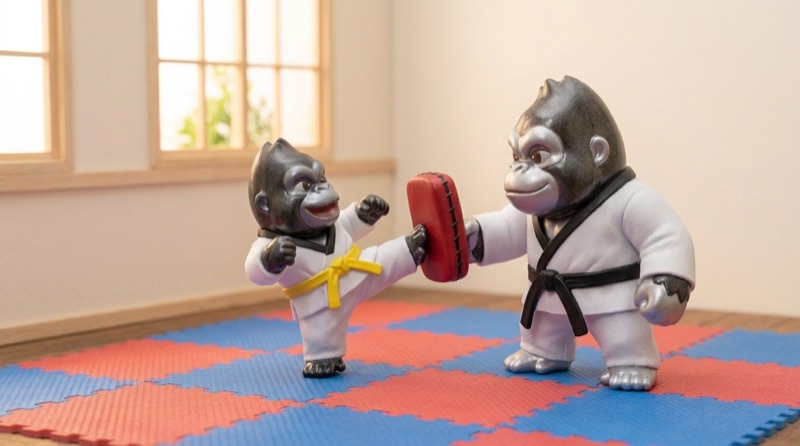
A full-body workout uses the large muscles of the upper body, lower body and trunk together, instead of training one area. A taekwondo kick looks like leg work, but the whole body produces it: the standing foot has to stay planted, the hips rotate, the core braces, and the hands protect the body. Over a class, you use everything from the soles of your feet to your shoulders.
This table lists common movements in a taekwondo class and the main body parts each one uses:
| Movement | Main body parts | What it trains |
|---|---|---|
| Kicks (front, roundhouse, side) | Thighs, glutes and calves, with the abdominal and back muscles stabilizing | Leg strength, power, single-leg balance |
| Footwork and jumps | Calves, ankles, thighs | Cardiorespiratory endurance, agility, impact loading for bones |
| Punches and blocks | Shoulders, arms, chest and back | Upper-body strength, reaction |
| Poomsae (forms) | Whole body | Coordination, balance, remembering a sequence |
| Conditioning | Depends on the exercise, such as squats, push-ups or core work | Strength, muscular endurance |
| Warm-up and stretching | Hips, hamstrings, shoulders | Flexibility, range of motion |
Poomsae are taekwondo's forms: a fixed sequence of movements, a bit like a set routine in gymnastics. Children have to remember the order and stop each movement in the right position, so they are training focus as well as their bodies.
Benefit 1: Better cardiorespiratory and muscular endurance
This is the benefit with the clearest research behind it. A 2019 meta-analysis combined 17 studies of elementary school students and concluded that taekwondo training helps children improve cardiorespiratory endurance and muscular endurance. The same study states plainly that it found little effect on other fitness measures.
A meta-analysis pools the results of many studies, which makes it more reliable than any single study. This one (Nam and Lim, 2019) found improvements in cardiorespiratory endurance, muscular endurance and power. After the researchers corrected for publication bias, the effect on power disappeared, so their conclusion keeps only cardiorespiratory and muscular endurance.
The takeaway for parents: no single sport does everything. Taekwondo is good for "going longer and kicking longer," but if you care about a specific skill such as throwing or swimming, your child will still need other activities.
Benefit 2: Three types of recommended activity in one class
Taiwan's Health Promotion Administration recommends that children aged 6 to 17 get at least 60 minutes of moderate to vigorous physical activity every day, including three types: aerobic activity, muscle-strengthening activity and bone-strengthening activity, with the last two at least three days a week. A taekwondo class covers all three.
| Recommended activity | Why it matters | In a taekwondo class |
|---|---|---|
| Aerobic activity | Improves heart and lung function | Continuous footwork, moving back and forth, kicking pads |
| Muscle strengthening (3+ days a week) | Builds muscle mass and strength | The leg work in every kick, plus the conditioning part of class |
| Bone strengthening (3+ days a week) | Bone mass increases most during adolescence | Jumps, step changes, landings and other movements with ground impact |
To be clear: one or two taekwondo classes a week does not mean your child reaches 60 minutes every day. The recommendation is daily, so on other days children still need to walk, run, jump and play outside. Think of taekwondo as the days in the week when all three types of activity happen at once.
Benefit 3: Balance, coordination and flexibility
When you kick, your body is supported on one foot most of the time, so taekwondo trains balance by its very nature. A 2022 systematic review of 16 studies on martial arts for children found that karate, judo, taekwondo and aikido programs helped improve cardiorespiratory fitness, speed, agility, strength, flexibility, coordination and balance.
A systematic review uses a fixed method to find and compare all the studies on a topic. Of the 16 studies in this review (Stamenković and colleagues, 2022), only 2 were about taekwondo. The rest covered karate, judo and aikido, so the findings describe martial arts as a group, not taekwondo alone.
Our Kids Class focuses on basic fitness, balance and coordination, with no sparring. Our view is that children aged 3 to 6 should first learn to enjoy moving and to move steadily. How high they can kick comes later.
Benefit 4: Focus and self-control
A taekwondo class has fixed rules: bow at the start and end, move only on the coach's command, and wait in line for your turn. Those rules are self-control practice in themselves. In one US study, 207 children from kindergarten to grade 5 took either taekwondo or regular physical education. After three months, the taekwondo group improved more in self-control, getting along with others and classroom behavior.
This study (Lakes and Hoyt, 2004) randomly assigned whole classes to each group and compared changes over three months. Besides self-control, the taekwondo group also improved more on a mental math test. The researchers also found that boys improved more than girls in attention-related self-control and classroom behavior.
Parents should keep two things in mind. First, this is a single study of a program run in schools, so it cannot promise the same change for every child. Second, in our view, the effect depends on how the class is taught. A class that only cares about kicking hard, without rules and etiquette, may not have the same effect.
How intense is taekwondo compared with other sports?
Exercise intensity can be compared using METs (metabolic equivalents). One MET is the energy you use sitting quietly, and a higher number means harder work. According to the 2024 Adult Compendium of Physical Activities, martial arts practice at a moderate pace, including taekwondo, is about 10.3 METs, higher than brisk walking, basketball or casual soccer.
| Activity | METs |
|---|---|
| Brisk walking (about 5.6 to 6.3 km/h) | 4.8 |
| Martial arts, slower pace, beginners | 5.3 |
| Swimming, freestyle, slow and recreational | 5.8 |
| Soccer, casual | 7.0 |
| Basketball, general | 7.5 |
| Martial arts, moderate pace (including taekwondo) | 10.3 |
| Jumping rope, moderate pace | 11.8 |
| Taekwondo, combat simulation | 14.3 |
Three things to keep in mind when reading this table:
- These are adult values. Children's actual energy use differs, so use the table only to compare which activity is harder.
- Beginners are at about 5.3 METs, similar to brisk walking or slow swimming. You will not be exhausted from day one. Fitness builds up gradually.
- A class is not at 10.3 METs the whole time. There is explanation, demonstration and rest, so the intensity rises and falls.
Is taekwondo good for adults starting from zero?
Yes. Cardiorespiratory endurance, strength, balance and flexibility matter just as much for adults, and taekwondo can be adjusted to your fitness level. At Yuan Power, adults with no experience start in the Basic Class or the Weekend Class, training alongside older children, and the coaches adjust for each person.
One grandmother in our Weekend Class first came just to bring her granddaughter. Later she started training too. She says taekwondo was not as scary as she expected, that climbing stairs feels easier now, and that she has more energy than before. That is her own experience, and everyone is different, but it shows one thing: taekwondo is not only for the young.
If you have a chronic condition or joint problems, or haven't exercised in a long time, check with your doctor before you start, and tell the coach about your health before class.
What our founder hears from parents
Research looks at the average across a group. A school sees one child at a time. Over the years, the changes parents report to us most often are better stamina, a stronger body, fewer colds, improved allergies and a stronger desire to learn. These are parents' observations, not research findings, but they point in the same direction as the studies above.
Over many years of teaching, I've heard from many parents that after their child started taekwondo, the child had more stamina, grew stronger, caught fewer colds, had fewer problems with allergies and became more eager to learn. Hearing this makes me very happy. It is what keeps me teaching and promoting exercise.
— Yuan Ming-che, founder, Yuan Power Taekwondo
One of our coaches, Chen Yi-en, is an example. She was often unwell as a small child. After she started taekwondo, her mother says, she had far fewer allergies and colds. Ten years later, she became a coach at Yuan Power.
Every child is different. If your child has allergies or another health condition, exercise can be part of the support, but please don't use it in place of your doctor's treatment and advice.
Which claims to take with a grain of salt: limits and risks
Taekwondo has real benefits, but be careful with three common claims: "taekwondo makes kids taller," "taekwondo alone will help you lose weight" and "taekwondo is perfectly safe, no one gets hurt." None of them is entirely true. When choosing a sport, weigh the benefits and the limits together.
Will taekwondo make my child taller?
There is currently no reliable evidence that taekwondo makes children grow taller than they otherwise would. Height depends mainly on genetics, nutrition and sleep. Taiwan's Health Promotion Administration notes that jumping and running stimulate bone development, and taekwondo does include those movements, but "supports development" is not the same as "guarantees height."
Can taekwondo help with weight loss?
Taekwondo is fairly intense, so it raises energy use and helps build muscle. But body weight depends mainly on diet. To manage weight, change exercise and eating habits together rather than relying on a few classes a week.
Will my child get hurt?
Every contact sport carries some risk of injury. A meta-analysis of 14 studies found that in competition taekwondo, the most common injuries were bruises to the lower limbs, almost always from contact, and most were minor. The researchers also recommended better protective equipment. Note that these figures come from competitions. Regular classes involve far less contact.
At Yuan Power, students always wear full protective gear for sparring. If even one piece is missing, they don't spar, and coaches watch every student's safety throughout. The Kids Class does no sparring. Whether to compete is entirely up to the student and their family.
What if my child is afraid of sparring?
Many children are nervous the first time they see sparring, and that's normal. Yuan Power has a complete, step-by-step method for teaching sparring that helps children adjust gradually. In our founder Yuan Ming-che's experience, almost every child who was afraid of sparring eventually accepts it and takes on the challenge, and some even sign up for competitions on their own.
This is another benefit of taekwondo: in an environment with rules, protective gear and a coach close by, children practice facing something they're afraid of. Whether to compete is still up to the child and their family.
How to start: choose a class by age
Start with age, then experience. Children aged 3 to 6 begin in the Kids Class, where the goals are balance, coordination and enjoying exercise. Everyone from elementary school age up, adults included, starts in the Basic Class or the Weekend Class with no experience needed. There's no need to train every day. Steady attendance matters more than training a lot at once.
| Class | Who it's for | Focus |
|---|---|---|
| Kids Class | Ages 3 to 6 | Basic fitness, balance, coordination, no sparring |
| Basic Class | Elementary school age and up, adults included, no experience needed | Fitness, kicking, poomsae |
| Weekend Class | Children and families who are busy on weekdays | Same as the Basic Class, on weekends |
| Advanced Class | Pre-black belts (red with black ends) and black belts | Harder training, more advanced technique |
One of our coaches, Chen Yi-en, trained two or three times a week as an elementary school student. Ten years later, she became a coach here. At Yuan Power, it takes about three years on average to go from white belt to black belt. The real time depends on how often a student trains, the age they start, and whether each rank is properly learned.
You can find class times on our schedule. Classes are taught in Mandarin.
Four common mistakes parents make
The most common mistake is judging progress only by how high a child kicks or how many medals they win. For most children, what matters more is better stamina, steadier movement and wanting to keep training.
- Only looking at kick height. Every child's natural flexibility is different. Compare your child with their past self, not with others.
- Expecting big changes in a month or two. Fitness builds gradually. Differences are usually easier to see after several months of regular classes.
- Making taekwondo a child's only exercise. The recommendation is daily activity, so children need to move on non-class days too.
- Rushing into competition before a child is ready. Competing is never required, and children who want to compete should build solid basics first.
Frequently asked questions
What are the benefits of taekwondo for kids?
The benefits with the most research support are better cardiorespiratory endurance and muscular endurance, the conclusion of a 2019 meta-analysis of 17 studies of elementary school students. Taekwondo kicks are mostly done on one leg, which trains balance and coordination. Bowing, following commands and waiting for a turn also train self-control. A class includes aerobic, strengthening and jumping movements, matching the three types of activity Taiwan's Health Promotion Administration recommends for children. Results vary by child and require regular training.
Is taekwondo a full-body workout?
Yes. A taekwondo kick uses more than the legs: the standing foot stays planted, the hips rotate, the abdominal and back muscles brace, and the hands guard or punch. Add footwork, jumps, poomsae and conditioning, and a class uses the large muscles of the lower body, trunk and upper body. According to the 2024 Adult Compendium of Physical Activities, martial arts practice at a moderate pace is about 10.3 METs, which counts as vigorous. Slower practice for beginners is about 5.3 METs, similar to brisk walking.
Does taekwondo make kids taller?
There is currently no reliable evidence that taekwondo makes children taller. Height depends mainly on genetics, nutrition and sleep. Taiwan's Health Promotion Administration notes that jumping and running stimulate bone development, and taekwondo's jumps and footwork are that kind of activity, so they support bone development. But supporting development is not the same as guaranteeing height. If you are concerned about your child's height, talk to a pediatrician rather than pinning your hopes on any one sport.
Can taekwondo help you lose weight?
Taekwondo can help, but not on its own. Moderate-pace taekwondo practice is vigorous exercise that raises energy use, and strength work helps build muscle. Body weight, though, depends mainly on diet. A few classes a week without changes to eating may not lower weight. To manage weight, change exercise and diet together. Children or adults with obesity or a chronic condition should first talk with a doctor about the right amount of exercise.
What age should kids start taekwondo?
At Yuan Power, children can try a class from age 3. The Kids Class for ages 3 to 6 focuses on basic fitness, balance and coordination, with no sparring, and aims first to help children enjoy exercise. Every child develops at a different pace, so the coach will see whether your child is ready during the trial class. If it's a little too early, we'll tell you honestly, and you're welcome to come back later. From elementary school age, including adults, beginners start in the Basic Class or the Weekend Class.
Summary
Taekwondo is a full-body workout: the legs kick, the core stabilizes, the arms guard, and constant movement raises the heart rate. The best-supported benefits are cardiorespiratory and muscular endurance, followed by balance, coordination and self-control. A class also covers the aerobic, muscle-strengthening and bone-strengthening activity that Taiwan's Health Promotion Administration recommends. It does not guarantee height, it is not a weight-loss plan on its own, and any contact carries some risk of injury, which is why protective gear and a coach close by matter.
The most direct way to find out whether taekwondo suits your child is a trial class. If you have questions, see our FAQ or message us on LINE.
Sources
- Health Promotion Administration, Ministry of Health and Welfare (Taiwan). Physical activity for children and adolescents (in Chinese).
- Health Promotion Administration, Ministry of Health and Welfare (Taiwan). More than half of elementary school students don't get enough exercise, 2023 (in Chinese).
- Nam SS, Lim K. Effects of Taekwondo training on physical fitness factors in Korean elementary students: A systematic review and meta-analysis. J Exerc Nutrition Biochem, 2019.
- Stamenković A, et al. Effects of Participating in Martial Arts in Children: A Systematic Review. Children (Basel), 2022.
- Lakes KD, Hoyt WT. Promoting self-regulation through school-based martial arts training. Journal of Applied Developmental Psychology, 2004.
- Herrmann SD, et al. 2024 Adult Compendium of Physical Activities.
- Lystad RP, Pollard H, Graham PL. Epidemiology of injuries in competition taekwondo: a meta-analysis of observational studies. J Sci Med Sport, 2009.